Field Service Management • 6 mins read
9 Best Practices for Successful Field Service Management

FieldEquip
Last Updated: August 9, 2024

Field service organizations face an overwhelming number of tasks each day.
Field equipment management, scheduling field personnel, inventory management, workflow management, creating and assigning field tickets, and much more.
Field service managers have lots on their plates.

More and more businesses embrace digitalization for more efficiency. Therefore, continuing with outdated, manual processes affects various aspects of your oil and gas business. You're likely experiencing inefficiencies, increasing costs, unsatisfied customers, and frequent downtime.
Implementing field service management best practices can help your oil and industrial field services organization achieve multiple benefits. These are streamlined operations, enhanced productivity, client satisfaction, maximum uptime, and improved employee retention rates.
Let's explore them in more detail.
Also Read: Discover the 5 Best Ways for Effortless Service Truck Inventory Management
Field Service Management Best Practices
1. Embrace Mobility
One of the field service management best practices is providing your personnel with a mobile field service management application. Your field technicians can instantly access the mobile app to view customer information, schedule work orders, and capture real-time data.
They can clock in and out from their device after each job, which ensures accurate payroll. Moreover, real-time notifications keep them in the loop on any changes to their schedule.
Field service technicians using mobile field service apps are better informed about job updates and safety procedures. They also collaborate seamlessly with other team members, which helps them achieve greater efficiency in their work.
2. Capture Real-Time Data
Top-rated organizations use powerful field service automation software. It captures real-time data from the field workforce or directly from the equipment to analyze performance-critical metrics.
Don’t lag behind your competitors. Choose a platform that is easy to use and offers real-time dashboards and reports. They will give you a comprehensive view of all past, current, and future field activities.
Improved scheduling and communication enable quicker problem resolution and transparency across all field service operations. This, in turn, will help you establish a more positive business image.
3. Foster Seamless Collaboration
An integrated field service management platform ensures all your customers, back-office team members, and field technicians are on the same page. This facilitates seamless collaboration and encourages job accountability and transparency.
Field service organizations can implement automated workflows to easily manage recurring tasks. This also helps speed up processes while minimizing manual intervention and errors.
Automation can considerably reduce response times. Field service personnel receive instant notifications about new tasks, their priority, the assigned personnel, the customer profile, etc.
4. Enhanced Visibility
Real-time visibility into all tasks and processes is critical. This allows all stakeholders to keep track of tasks, identify potential loopholes, and take necessary corrective actions.
Real-time tracking provides the latest site and activity information of your field technicians and equipment. This allows field and back office managers to check staff availability and location. Thus, they can assign tasks to the field crew with the right skills and the shortest travel time to maximize overall technician productivity.
Accurate equipment performance data allows oil field service technicians and supervisors to schedule preventive and predictive maintenance programs. So, they can ensure maximum uptime and enhanced worker safety.
Also Read:Oilfield Services Management Software Becomes Important Than Ever for Oil Companies
5. Leverage Intelligent Scheduling and Dispatching
Intelligent scheduling and dispatching are critical to field service management organizations. The expectations of today's customers are continuously growing. They want service providers to proactively offer equipment servicing and maintenance as well as to be highly responsive in emergencies.
Also, customers expect well-qualified field technicians to deliver quality service, thus adding value to their field operations.
Here’s how the oil and industrial field services industry can leverage field service scheduling and dispatch:
- Get instant real-time access to vital information to timely meet customers’ needs.
- Filter work orders and resources as per requirements.
- Match the best available field personnel to jobs as per specifications.
- Prevent scheduling conflicts and inappropriate resource utilization.
- Elevate customer experience through precise arrival times and timely completion of tasks, enhancing reliability and transparency.
- Optimize routes to reduce travel time and fuel consumption, contributing to lower emissions.
- Pick field service management software with inbuilt scheduling and dispatch. Such software is scalable, i.e., you can configure it to meet dynamic operational needs.
6. Efficient Employee Time Tracking
Minimizing time wastage or unnecessary time consumption remains one of the main challenges for field service organizations. This is especially true for those operating in the oil and gas sector, where providing timely services is essential.
Here’s why accurate time tracking in field service management is replacing manual time tracking at a fast pace:
- Digital time tracking precisely records clock-in and clock-out times of your field technicians. This encourages accountability and transparency at work.
- Accurate time tracking is among field service management best practices. Oil & gas and industrial field service companies can bill clients accurately based on actual work hours clocked. This improves cash flow and profitability.
- Accurate time tracking paves the way for fair field personnel compensation. It also increases job satisfaction while boosting productivity and morale.
- Digital time tracking helps managers analyze time spent on different tasks. As a result, they can identify areas for improvement to further boost operational efficiency.
Automated time tracking can benefit you in various ways. Nonetheless, choosing the right time-tracking software that offers a complete solution for field service organizations is key. Look for one with features such as GPS tracking, Third-party Integration, Bulk entry, and Timecards.
7. Effective Inventory and Resource Management
Field service businesses often need help with issues like inventory shortage, shifts in demand, risk of damage or theft, and over-stocking. Smart inventory management helps optimize operations, improve service delivery, and ensure customer satisfaction.
As one of the field service management best practices, smart inventory management can help field service businesses in various ways:
- Help field technicians quickly find required parts and save a lot of time in the process.
- Reduce the chances of parts failure and unavailability.
- Reduce operating costs and improve customer satisfaction.
- Balance inventory levels to prevent overstocking of spare parts.
- Provide instant access to spare parts inventory information in real-time, from anywhere.
- Create stock transfer requests using a mobile application.
Asset information includes service history, service manuals, current output, schematics, and more. Instant access to it provides your field service technicians and roustabout crew with valuable insight. It enhances troubleshooting and repair processes, leading to timely resolution and improved customer satisfaction.
8. Quality Service and Contract Management
Quality service and contract management are critical for field service businesses. They help ensure compliance, customer satisfaction, and revenue gains.
Here’s how equipment-specific checklists help field service technicians deliver comprehensive and consistent troubleshooting, servicing, and maintenance of different types of equipment:
- Field service technicians can follow standardized procedures for servicing different equipment types
- Equipment-specific checklists cover all vital inspection and maintenance tasks that technicians must perform. This aligns service tasks with industry standards
- Checklists can serve as a reference tool for experienced technicians. Meanwhile, new ones can use them to learn standard equipment servicing procedures.
- Technicians work in a safe environment as checklists include all safety protocols they must follow during servicing
Contract management allows field service companies to create tailored service agreements based on every client’s unique requirements. Tracking key metrics such as job completion rates and response times helps managers review performance and analyze areas of improvement.
9. IoT Integration and Predictive Maintenance
Internet of Things (IoT) equipment monitoring and predictive maintenance are powerful next-gen technologies. They help oil and industrial field companies maximize asset uptime. It can also significantly improve servicing quality. Here's how:
- Installed sensors facilitate real-time monitoring of real-time equipment performance metrics. These include temperature, operating hours, vibration, pressure, and more.
- They eliminate human intervention through continuous collection and interpretation of data.
- Remote access enables proactive monitoring and troubleshooting.
- These technologies help identify current issues and potential equipment breakdowns. As a result, this facilitates the scheduling of preventive and predictive maintenance programs
- Timely and proactive equipment servicing ensures maximum uptime.

Intelligent Analytical Models in the form of informative charts and reports provide enhanced visibility into equipment performance metrics. By analyzing the data, the management can make timely decisions. Thus, your company can ensure optimal equipment performance. You can also improve work safety standards and deliver exceptional service to valued clients.
Final Thought
The field service industry continues to get more competitive through digitalization. Thus, decision makers must implement field service management best practices. This will ensure optimal equipment and personnel performance while eliminating outdated, tedious manual input processes.
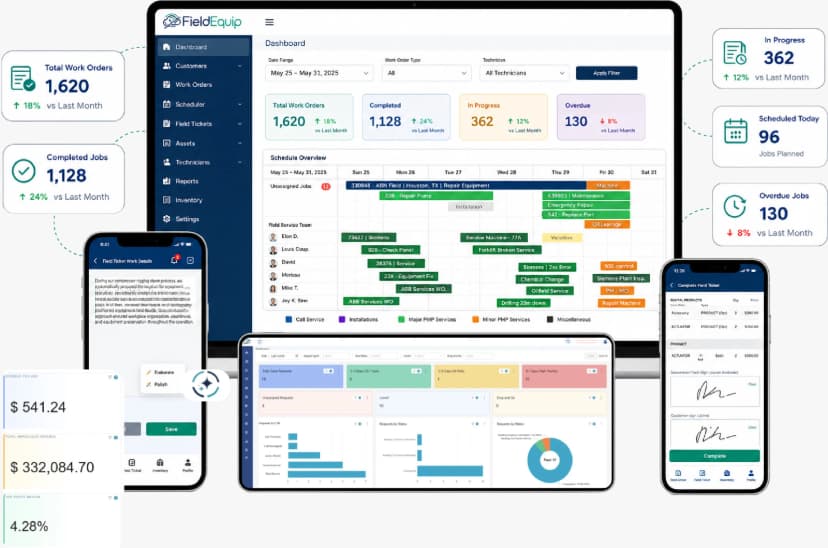
To achieve the best results, you will have to invest in powerful, robust, and reliable field service management software like FieldEquip. It offers a host of next-gen features, such as field ticketing, work order management, scheduling and dispatch, preventive maintenance, and more.
A Clearer Way to Run Field
Service Operations
Field service challenges are not just operational. They directly affect cash flow, billing accuracy, and scalability.
Schedule a Demo